The CRM system is often one of the most essential systems in any organization, whether in the private, public, or third sector (such as associations). Today, the quality of a CRM system and how it fits the company’s business can be a decisive factor in how well the organization succeeds in taking care of its customers and acquiring new ones. We investigated which CRM systems are the most common in Finland in 2025, as well as what kind of use cases and organizations they are best suited for.
North Patrol is a consulting firm specialized in the design of digital services and information systems. We shape ideas into a vision and service concept, find the best architectural and technological solutions, design a functional user experience, and compete to find the ideal partner for implementation work. We do not sell implementation projects, nor do we sell licenses; we are genuinely on the side of the customer.

7 May 2025
In a nutshell, a CRM (Customer Relationship Management) system is used to manage customer data. At its simplest, it can serve as a centralized place to store contact details, but in practice, it typically does much more. CRM systems are commonly used to bring together all customer-related activities, including communication, relationship management, sales, and marketing.
CRM systems typically include tools for managing organizational and contact data, as well as tracking sales leads and opportunities. Most systems focus on sales and marketing, offering features to manage, monitor, and improve these processes. They also support task management and communication with contacts, making them much more than simple customer databases.
Scope of the review
Accurate statistics on CRM tools and their prevalence are limited, since these are by nature internal. However, insights into their adoption and typical use cases can still be gathered from various sources. This article presents an expert assessment of the most popular CRM solutions in Finland, based on multiple data sources.
This review focuses primarily on general-purpose CRM systems. One of the key criteria was that the product must have a credible presence in Finland. In practice, this means that the vendor or its partners generate significant CRM-related business locally, typically at least around one million euros in annual revenue. As a result, products such as Vine CRM and Melba CRM are not examined in detail.
It can sometimes be difficult to draw a clear line between different types of solutions and the acronyms used to describe them. For example, CDP (Customer Data Platform) systems, such as Custobar or Bloomreach, have recently gained popularity among large consumer-facing companies. While CDPs do include many CRM-like capabilities, they are designed for a different primary purpose and are therefore not the focus of this review. Similarly, software primarily intended for financial administration has been excluded, even though such systems may also offer CRM functionality.
Many industries have their own highly specialized CRM solutions, which are typically not used outside their specific domain. We have, however, included some of the most common ones of these in this review, as they have significant business in Finland and have, in many cases, become de facto standard within their respective industries.
A more detailed description of the methods and data sources used in this analysis can be found at the end of the article.
CRM is used by two thirds of companies
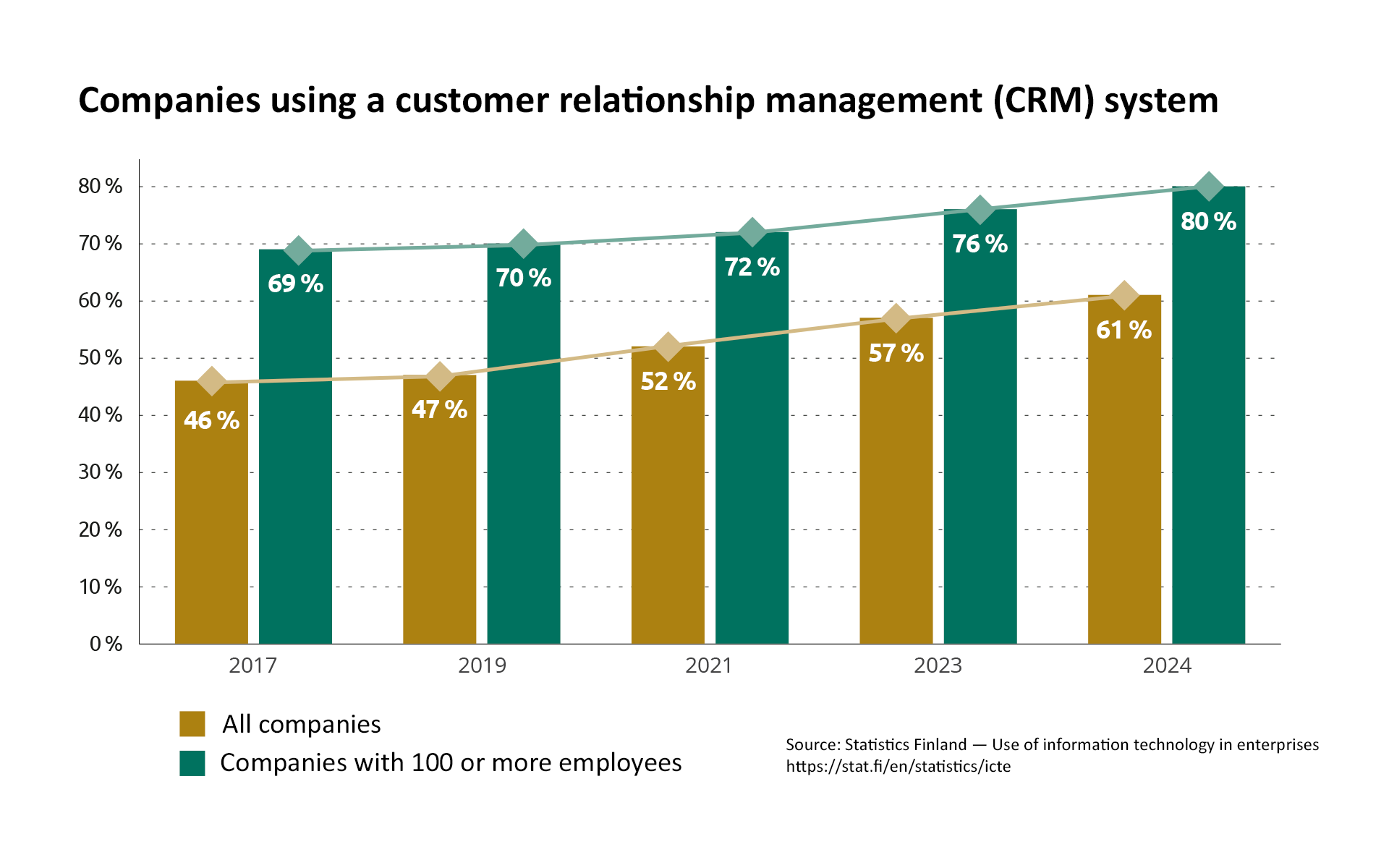
According to annual statistics published by Statistics Finland, 61% of Finnish companies used a CRM system in 2024 (Statistics Finland: Use of information technology in enterprises). CRM systems are more common in larger organizations. Among companies with more than 100 employees, 80% use a CRM system.
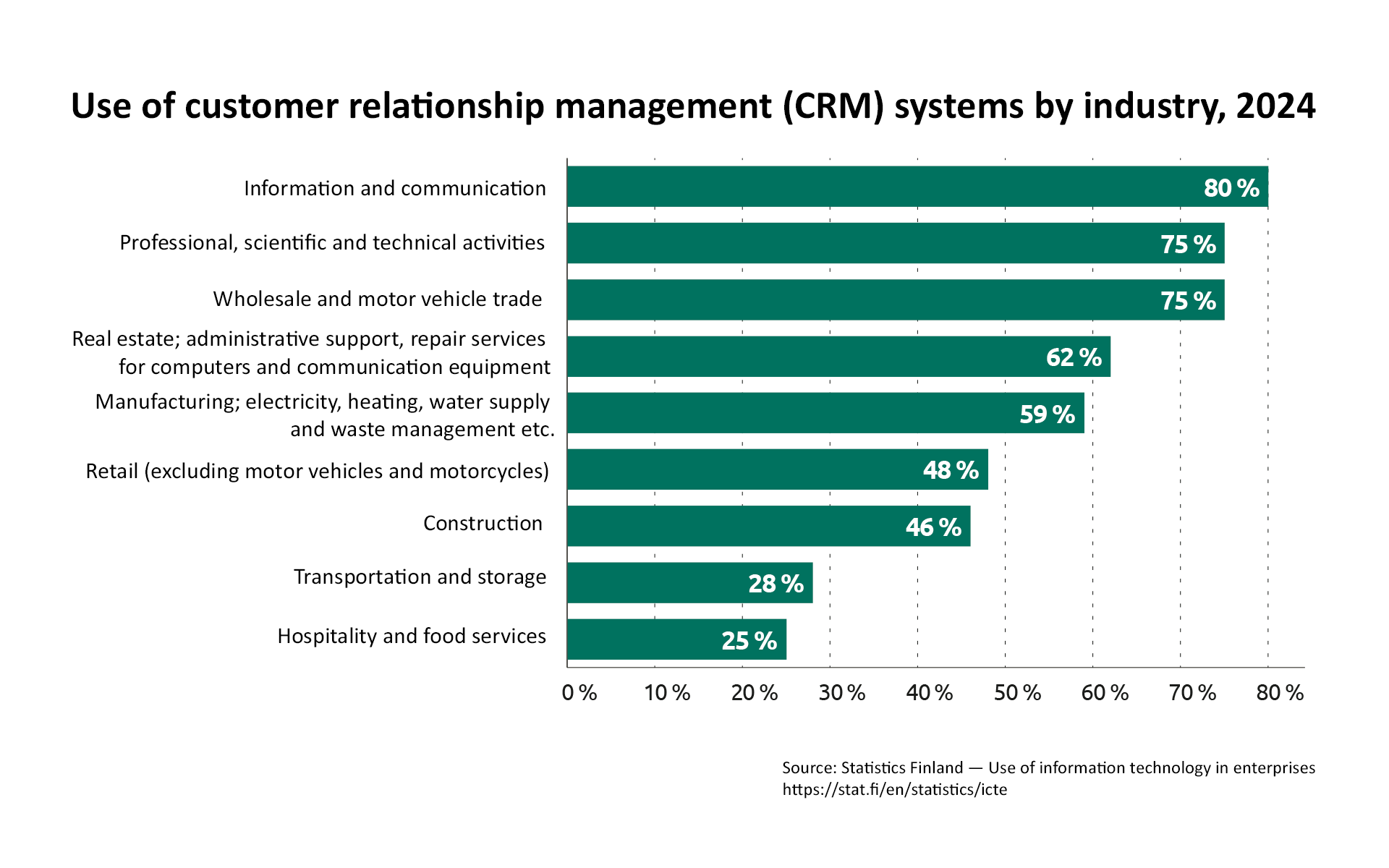
An industry comparison shows that CRM systems are most widely used in organizations focused on information work and communications (80%), professional, scientific and technical activities (75%), and wholesale and motor vehicle trade (75%). Differences between industries are likely driven by factors such as prevalence of B2B business, the importance of individual customer relationships and the average size of organizations. In many sectors, the core business system is an ERP, with customer relationships managed as part of that overall solution.
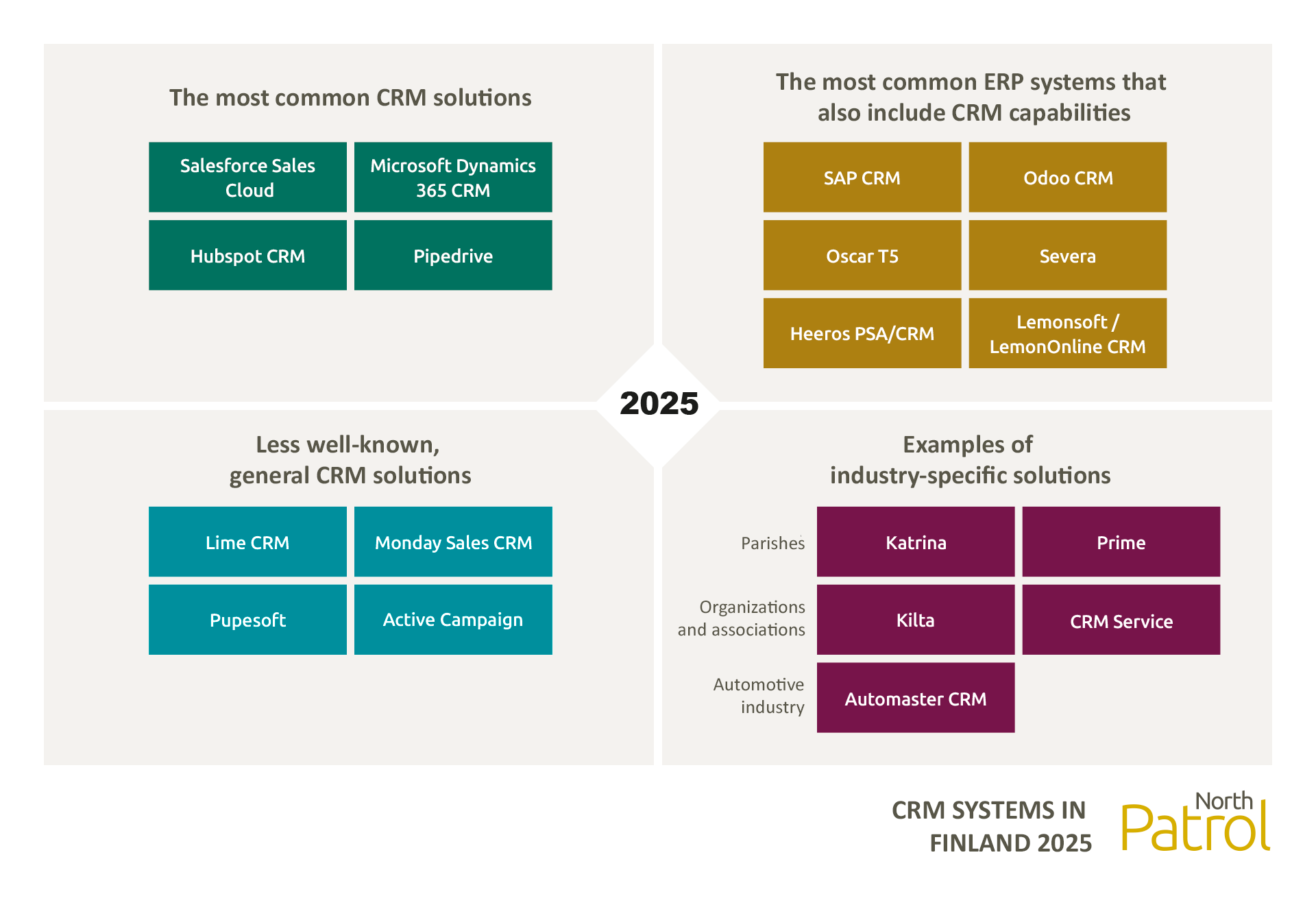
The most common CRM solutions in Finland
For this review, we have gathered data from multiple sources on how common different systems are and how widely they are used. Some of the information is based on public and paid online services, such as LinkedIn and BuiltWith, while other insights have been collected from companies’ own websites. In addition, we have drawn on expertise accumulated through North Patrol’s previous CRM projects.
The four most common CRM solutions are presented below, primarily ranked according to our estimate of the number of professionals in Finland with expertise in each system.
Salesforce Sales Cloud
Salesforce Sales Cloud is one of the world’s leading CRM solutions, offering a wide range of products and cloud services for different needs. These include Sales Cloud for sales management, Service Cloud for customer service, and Marketing Cloud for marketing automation. For smaller businesses, Salesforce also offers a dedicated Small Business package, which is tailored to their specific needs. Pricing starts at €25 per user per month, while enterprise-level plans with more advanced features typically begin at around €150 per user per month.
Salesforce also allows organizations to build a wide range of custom solutions using the Salesforce Platform, a platform-as-a-service (PaaS) offering for developing cloud-based applications and websites.
Salesforce is often the preferred choice for large enterprises and corporate groups. For example, telecommunications operators such as Telia, Elisa, and DNA, as well as major retail companies, use Salesforce for customer relationship management, sales tracking, and marketing automation. It is also widely used in the financial and insurance sectors, by companies such as If and Fennia, for managing customer data, automating service processes, and enhancing the customer experience. In addition, Salesforce is used in the public sector and in educational institutions, such as the Finnish Tax Administration and Aalto University, to support customer engagement and student management.
In Finland, there are several thousand professionals, both on the vendor and customer side, with extensive experience working with Salesforce CRM solutions.
Microsoft Dynamics 365 CRM
Microsoft Dynamics 365 (D365) is a broad suite of cloud services that covers both enterprise resource planning (ERP) and customer relationship management (CRM), with different applications designed for a wide range of needs. When people refer to “Dynamics CRM,” they are typically talking about the Sales, Customer Service, and Customer Insights applications, which are used for sales, marketing, and customer relationship management.
Dynamics 365 is built on Microsoft’s Power Platform, which enables flexible customization of views and data structures to meet specific business needs. It also integrates well with other Microsoft tools, such as Office 365, Teams, Power BI, and the Power Platform components, including Power Apps and Power Automate.
Dynamics is still used in many organizations as an on-premises installation, but almost all new implementations are now carried out in the D365 cloud environment.
Microsoft is well established in the CRM market in Finland. Thanks to its flexibility, integration capabilities, and the overall popularity of Microsoft solutions, there are several thousand professionals in Finland, both among vendors and customers, with extensive experience of different versions of Dynamics CRM and with a strong understanding of the platform.
Dynamics 365 is most commonly chosen by large and mid-sized organizations and corporate groups that already make extensive use of Microsoft’s other services and need to manage large volumes of customer organizations and contacts. In these cases, the system is used to manage not only master data but also a wide range of customer-related interactions, including leads and opportunities, quotations, customer-specific pricing, contracts, and more.
MS D365 has also been widely adopted in the public sector and in larger cities. For example, it is used extensively by HUS and the City of Tampere. The Federation of Finnish Enterprises also uses solutions from the Microsoft Dynamics 365 product family to manage its member data.
However, due to the variety of packaging options and Microsoft’s user-based pricing model, determining the right combination of licenses can be surprisingly difficult. Even Microsoft doesn’t always provide entirely clear guidance. Depending on how the rules are interpreted, end users may also need to be counted as licensed users, particularly if they can edit their own data through self-service interfaces. That said, when the number of required licenses is relatively small, Dynamics 365 can still be implemented quickly and at a reasonable cost.
HubSpot CRM
HubSpot is another well-known cloud-based platform, offering a versatile set of tools for sales, marketing, and customer service. It provides an easy way to manage customer profiles, contacts, quotes, and other customer-related data. Its marketing automation capabilities are particularly strong, and it is especially popular for acquiring and nurturing leads through automated workflows. For businesses focused on digital customer engagement, HubSpot brings websites, campaigns, A/B testing, and more into a single platform.
HubSpot offers a wide range of ready-made integrations with third-party systems, enabling seamless data sharing and process automation across different applications. These integrations cover a broad set of business needs, including email services, external CRM systems, e-commerce platforms, and financial management software.
There are several dozen companies in Finland offering HubSpot solutions and services. Within HubSpot’s partner program, these companies are classified into different tiers based on their expertise and experience. Overall, there are several hundred professionals in Finland with solid expertise in HubSpot CRM and its different modules well. While the number of specialists is not quite on the same level as for Microsoft and Salesforce, HubSpot is nevertheless a widely used and well-recognized platform in Finland.
HubSpot is particularly popular among small and medium-sized businesses and growth companies, but it is also widely used by larger organizations. In Finland, the largest user groups include technology companies, marketing agencies, SMBs, and educational institutions.
HubSpot offers a free version for individual users or small teams, but costs can rise quickly as needs and requirements grow. HubSpot provides different packages and pricing tiers, but in general, pricing is largely based on number of contacts and volume of email sent. The Marketing Hub Professional plan starts at around €800 per month, while the Enterprise version costs approximately €3,300 per month. At that point, the investment is no longer insignificant, especially for smaller organizations.
Pipedrive
Pipedrive is a cloud-based CRM and one of the most popular options in Finland for small businesses. It offers user-friendly tools for managing leads, contacts, quotes, and deals, along with automated workflows and a clear Kanban-style interface for managing sales pipelines. It also includes a mobile version that is widely praised for its usability.
Pipedrive is often chosen for its ease of use, clear visual sales pipeline, and strong integration capabilities. Integrations with tools like Teams, Outlook, and Slack help streamline workflows by bringing communication into one place. And with the Leadfeeder integration, for example, leads can easily be transferred into Pipedrive or sent directly by email to resellers.
Pipedrive generates substantial global revenue, approaching $200 million. In Finland, however, there are only a few certified Pipedrive partners, and among them, only Zimple exceeds the cut-off threshold used in this review. As a result, the number of professionals in Finland is measured in tens rather than hundreds or thousands, though the business is still clearly significant. For example, Zimple reported €1.7 million in revenue in 2023, generated by a team of seven people. In Finland, Pipedrive is used, for instance, by HIFK for match and event sales, and by Wolt for managing sales processes.
Pipedrive offers a 14-day free trial, after which pricing is based on the number of users. The entry-level Essential plan starts at €14 per user per month, while the Enterprise plan costs €99 per user per month. When choosing a plan and estimating costs, it’s important to review the features carefully. For example, email synchronization is only available from the Advanced plan onward. According to Pipedrive, the most popular option is the Professional plan, priced at €49 per user per month, which includes tools for contract and quotation management, as well as reporting and sales forecasting.
The most common ERP systems that also include CRM capabilities
Enterprise resource planning (ERP) systems differ from CRM systems in that they are primarily designed to plan and manage a company’s operations and resources. In practice, however, the distinction is not always clear, as many products and platforms include features, or at least modules, for both purposes.
In this review, we have drawn the line so that products with broad capabilities in areas such as manufacturing, supply chain management, inventory management, financial management, or the sales and lifecycle management of products or services are classified primarily as ERP systems.
That said, the boundary is not absolute. A few platforms that we consider ERP systems but that also offer extensive CRM capabilities are worth highlighting here.
SAP Customer Experience
Like Dynamics and Salesforce, SAP is a global enterprise platform, but it places a stronger emphasis on large-scale production and operations. That said, SAP also offers a range of dedicated CRM and Customer Experience solutions, including SAP Customer Data Platform for managing customer data, SAP Sales Cloud for sales processes, SAP Emarsys for marketing automation, and SAP Service Cloud for customer service.
SAP has a well-established position in Finland, supported by a strong partner network and significant business activity. It is used primarily by large enterprises and industrial companies, such as ABB, Valmet, Metsä Group, UPM, and Cargotec. A common denominator for these organizations is that customer relationships are typically long-term and the systems are used to manage end-to-end business processes.
SAP’s partners are also, in most cases, large international consulting firms with annual revenues in the tens of millions of euros or more, including Accenture, Deloitte, Capgemini, PwC, IBM, Fujitsu, Tieto, and CGI. Some smaller but still notable partners include Vincit (€70M in 2023), Infosys Limited (approx. €16M in 2024), Atos (approx. €12M in 2023), Islet Group (€10M in 2023), and Sofigate (approx. €7M in 2023).
As with Dynamics 365 and Salesforce, SAP should not be implemented as a standalone CRM solution. In practice, its use typically spans the entire organization, and it is best suited to companies with substantial scale and complexity. Even with a relatively small number of users, annual costs can reach tens of thousands of euros, while in larger organizations they can quickly rise to hundreds of thousands or even millions. Another defining feature of these large platforms is the need for extensive and ongoing consulting services, which should also be considered when estimating total lifecycle costs.
Odoo CRM
Many people think of Odoo primarily as an ERP system, but in reality, it is a broad open-source suite of business applications, where ERP and CRM functionalities are just part of a much larger whole. The platform includes applications for sales and marketing, finance, HR, product lifecycle management, inventory management, website creation, and more.
Odoo is available both as Odoo Online, a cloud-based service, and as a version installed in a dedicated hosting environment. The online version is free when using a single application (such as CRM only). The standard online package, which includes all applications, is priced at €19.90 per user per month, while the Custom version hosted on a server costs €29.90 per user per month. As an open-source system, Odoo can also be deployed independently without license fees.
A wide range of add-ons is available for Odoo, either directly or through partner-supported implementations, most of which come at an additional cost. Add-ons also enable integrations with third-party services such as Mailchimp or MailerLite for email marketing, and WooCommerce, Shopify, or Magento 2 for e-commerce.
Although the system can be installed independently, it is usually advisable to work with a partner that has strong expertise in the platform. This helps ensure that customer relationship management processes are best aligned with Odoo’s capabilities and that version upgrades can be carried out smoothly.
While the open-source nature of Odoo allows even its core functionalities to be customized, this is rarely recommended, as it can make future upgrades more difficult. Fortunately, the core system is already flexible enough to support a wide range of use cases without heavy customization.
Practice has shown that most organizations using Odoo tend to opt for the Custom version, largely due to its flexibility, API capabilities, and more robust support options. Although hosting comes with some additional costs, it is worth noting that the standard package already includes all applications, so enabling new modules does not increase licensing fees. Organizations can also start with a single application, such as CRM, and expand their use over time. In many cases, Odoo can replace several previously separate systems
There are around ten Odoo partners in Finland, including two Gold-level partners (SprintIT and Avoin.Systems) and one Silver-level partner (ERPWare). According to the latest available figures (2024), both SprintIT and Avoin.Systems generate more than €1 million in annual revenue (SprintIT Finland €5.5M, Avoin.Systems €2.6M). Finnish reference customers include Pekkaniska, Tekniikan Akateemiset ry, and Suomalainen Kirjakauppa.
As an open-source system, Odoo differs from the other solutions covered in this report, but it is not the only open-source CRM available. Other examples include Dolibarr CRM and SuiteCRM (formerly SugarCRM). However, these do not appear to generate significant business in Finland and have therefore been excluded from the scope of this review.
Oscar T5
Like Odoo, Oscar T5 by the Finnish company Oscar Software is primarily an ERP system, but even its smallest Lite version includes CRM functionality that combines customer, sales, and order data with core ERP information. In 2024, Oscar Software generated more than €12 million in revenue with a workforce of just over one hundred employees.
Core CRM features are included in the Lite version (from €279 per month, with additional users at €40 per month), while more advanced sales support capabilities are available in the Basic and Premium versions (from €479 and €779 per month respectively, with additional users at €65 per month).
T5 is primarily designed for the manufacturing industry and wholesale trade, but it can also be used in other sectors. When its ERP capabilities match the organization’s needs, it can serve as a natural solution for managing customer data. However, it is not well suited as a standalone CRM, especially if the aim is to manage and develop marketing processes within the same system.
Severa
Severa, developed by Visma Solutions Oy, is a customer and project management system designed particularly for expert organizations. In addition to project management, it includes tools for managing and monitoring the sales pipeline, such as task management, calendars, quotation creation, and sales tracking and forecasting. For organizations looking for marketing-oriented CRM capabilities, Severa is likely not sufficient on its own. However, it offers extensive integration capabilities and a wide range of ready-made connectors for linking other systems, such as HubSpot, into the sales process.
The Basic version of Severa, which includes core CRM functionality, starts at €29 per user per month, while the most comprehensive Enterprise version is priced at €75 per user per month. As is common with user-based pricing models, the per-user cost typically decreases as the number of licenses increases.
In 2023, Visma Solutions Oy reported €132 million in revenue. While Severa’s share is not disclosed separately, it can be estimated to amount to several million euros
Heeros PSA/CRM
In this review, Heeros PSA falls into the same category as Oscar T5. While it generates significant business in Finland (Heeros Oyj’s revenue in 2024 was nearly €10 million), it is primarily an ERP system designed for expert organizations. CRM plays an important role within the platform, but it is not intended to function as a standalone CRM or a marketing-focused solution. Instead, it is widely used to support contact management, quotation processes, invoicing, and sales forecasting as part of a broader ERP setup.
The Growth package, which includes CRM functionality, starts at €19 per user per month. More advanced sales and project management features are available in the Business and Enterprise packages, priced at €29 and €39 per user per month, respectively.
LemonOnline CRM
LemonOnline CRM is a browser-based customer relationship management system that is part of Lemonsoft’s ERP platform. It is designed primarily for small and medium-sized businesses and includes tools for managing customers, sales, and marketing activities.
CRM functionality is available from the O1 package onward (from €36 per user per month). In addition, a company-specific base fee applies, depending on the organization’s needs. In 2024, Lemonsoft Group generated €29 million in revenue in Finland, of which around €20 million came from SaaS services. LemonOnline’s share of this is not reported separately.
Less well-known CRM solutions
Choosing well-known CRM systems like those mentioned above can often feel like a safe option. These platforms cover the core features required for most common use cases, and support is readily available through multiple partners. However, they are typically priced accordingly, and user-based pricing in particular can become unexpectedly expensive. For this reason, it is worth to consider alternative solutions as well.
As a part of this review, we examined more than one hundred CRM products. From these, we selected a few that is known to be used in Finland and for which there are credible partners available to support development and maintenance. While not all of these meet the one-million-euro revenue threshold, they are at least close to it.
General-purpose CRM solutions
Lime CRM is developed by the Swedish company Lime Technologies and is designed primarily for small and medium-sized businesses as well as public sector organizations. It offers a versatile set of tools for managing customer data, tracking sales, handling customer service, and supporting marketing activities.
As many other CRMs, Lime is also priced per-user. The starter package begins at €55 per user per month, the Business package at €95, and the Enterprise version at €170 per user per month.
In Finland, Lime is represented by Lime Technologies Finland, which generated approximately €3.3 million in revenue in 2023 with a team of around twenty employees. While many of its reference customers are in its home market Sweden, it also has a number of Finnish references, including Beverage Partners Finland, Snellman, and Nurmijärven Sähkö, the energy services company owned by the municipality of Nurmijärvi.
Monday.com is also a popular cloud service in Finland, most often used for project management, but it also includes a Sales CRM module for managing the sales cycle and automating repetitive tasks. It is highly customizable, offering many add-ons, and it integrates well with commonly used sales and marketing support tools such as Mailchimp, Google tools, Teams, and Slack.
The Basic package for Monday Sales CRM starts at €12 per user per month, but in practice, most organizations choose between the Standard (€17 per user per month) and Pro (€28 per user per month) plans, which offer more advanced features.
Globally, Monday.com is used by over 200,000 organizations and generates close to one billion euros in revenue. In Finland, the only official partner is Gapps Group, which reported revenue of just under €800,000 in 2023. Finnish references include the event company Pågå and Sharper Shape, a company operating globally in solutions for electricity transmission and distribution.
Pupesoft is a cloud-based production management system developed by the Finnish company Ahkio Consulting Oy, designed particularly for wholesale businesses in Finland. In addition to ERP functionality, it includes capabilities for customer relationship management, especially in areas such as sales (including POS), inventory management, financial administration, and invoicing. Ahkio Consulting’s revenue in 2023 was €850,000, although this is not generated solely by Pupesoft. The company also delivers Odoo projects (as a basic-level Odoo partner) and various support services.
ActiveCampaign is most commonly associated with marketing automation. It is not typically considered a full-featured CRM system, but is often used alongside one. Its strengths lie in automating marketing communications and targeting content. However, it also includes tools for tracking and analyzing customer relationships, leads, and sales processes.
Industry-specific solutions
There are also CRM solutions on the market that have been developed specifically for the needs of a single industry, or that have evolved into such solutions over time. These industry-specific systems are typically shaped by the priorities of individual vendors, and their development and lifecycle depend largely on the decisions made by those vendors.
In reality, even industry-specific CRM solutions very often need customer-specific customization, because organizations want to develop their operations at different speeds, and a so-called basic version may not as such meet the organization’s special requirements. This creates its own challenges for system vendors, which must be able both to offer new customers an up-to-date solution suitable for future needs and to support and further develop customer-specific solutions that have already moved onto their own development paths. Due in part to vendors’ limited resources, industry-specific CRM solutions have in fact fallen behind other CRM solutions in development.
In practice, even industry-specific CRM solutions often require customizations, as organizations develop their operations differently and standard versions do not always meet their specific requirements. This poses a challenge for vendors, who must be able both to offer new customers modern, future-ready solutions and to support and further develop existing customer-specific implementations that may have diverged over time.
Partly due to limited resources, industry-specific CRM solutions have in many cases lagged behind more general-purpose systems in terms of development. As a result, their user experience is often outdated, and further development is hindered by technical debt that has grown too large.
Katrina and Prime are CRM systems used by Finnish parishes. They are designed to support parish processes as well as related administrative and operational tasks, and they integrate with other parish systems. In addition to managing membership registers and church services and ceremonies, both systems include functionalities for event management, space reservations, resource management, customer communication, and invoicing.
Katrina, supplied and maintained by Vitec Software Group, is used by approximately 75% of Finnish parishes. Prime is used by, among others, the parishes of Oulu, Lahti, and Helsinki. Originally developed as a CRM product by Innofactor Oyj, Prime has been delivered and maintained by TSS Prime Oy since 2021.
Kilta and CRM-service are examples of CRM solutions tailored specifically for organizations, federations, and associations. At their core is a combined customer and membership register, complemented by features that support the full lifecycle of association activities, spanning from member acquisition to invoicing, communication, and event management. Both systems also include functionalities for member self-service portals.
Kilta is developed by the Finnish company Kehätieto Oy and is used by a wide range of organizations, including trade unions, industry associations, youth and hobby organizations, and social and healthcare organizations. Its users include WWF, Tehy, STL, SPEK, SOSTE, the Finnish Association for Nature Conservation, Pro, the Automobile and Touring Club of Finland, and YTK.
CRM-service, developed and maintained by CRM-service Oy, offers a version tailored for non-profit organizations, used for example by the Mannerheim League for Child Welfare. In addition, CRM-service provides a separate version designed for B2B organizations.
Automaster DMS is widely used by Finnish car dealerships and service centers, supporting customer relationship management as well as vehicle and spare parts sales and service operations. It is used to manage customer and vehicle data, quotes and work orders, appointments, service and repair work, and invoicing.
Automaster also offers several ready-made integrations, including connections to Traficom’s vehicle and customer data. Originally developed in Finland, the system is now owned by Keyloop. Its Finnish operations are managed by Keyloop (Finland) Oy, based in Oulu, while outside Finland it is resold by partners such as Amit in the Baltics.
Globally, the range of CRM systems is enormous
The market position of leading CRM platforms in Finland differs somewhat from that seen in, for example, the North American market reflected in Gartner’s reports. Gartner includes products such as Zoho CRM, Freshworks, eGain, and Pegasystems, but these have only a few individual implementations in Finland that we know of.
The same goes for e.g. Upsales, which has gained a relatively strong foothold in Sweden, and Vtiger CRM, which is available both as an open-source solution and a broader cloud version. To our knowledge, neither has a credible partner or supplier ecosystem in Finland.
Summary
Salesforce and Dynamics 365 largely compete for the same customer segment in practice, and both platforms are priced based on the number of users. Of the two, Salesforce often ends up being more expensive, especially when enterprise-level features are required, the user base is large, or the solution is extended with additional paid add-ons, of which there are many available.
For both Salesforce and Dynamics 365, it is important to note that they are not intended to solve a single, isolated need. There are plenty of lighter alternatives for that. Instead, the decision should be approached from a broader ecosystem perspective. For organizations already committed to the Microsoft environment, Dynamics 365 has an advantage, whereas for internationally oriented, growth-driven companies, the Salesforce ecosystem may be a more natural choice.
With these giants of the CRM world, it is wise to prepare for the possibility that significant sums may need to be invested in deployment, training, and continuous development. Product packaging is often only the starting point, which then needs to be adapted to actual business needs.
Although initial implementation with a basic setup and low-code tools can be relatively quick, adapting the system to specific business processes often demands more time and resources than anticipated. The customizations that are typically carried out by external partners should therefore be carefully evaluated, to avoid surprises in both workload and cost.
For very small organizations or simple customer management needs, Salesforce and Dynamics 365 are often unnecessarily heavy solutions. In such cases, alternatives like HubSpot, known for its strong marketing automation and integration capabilities, or Pipedrive, which is popular among SMBs for its ease of use and more moderate pricing, may be better suited.
It is also worth carefully evaluating other options. The best fit may well be found in a smaller CRM solution, an industry-specific system, or even within an ERP platform.
Ultimately, choosing the right CRM solution is a combination of many factors. The key is to start with a thorough needs assessment and only then make technology decisions, ensuring they are aligned with the organization’s goals and requirements.
About this review
This review is based on publicly available data as well as North Patrol’s experience from CRM-related client projects. Sources include, for example, reference information published by system vendors, along with public procurement notices and contract award announcements submitted to the Hilma service for public procurements.
The financial figures presented for different companies are primarily based on their latest published financial statements in Suomen Asiakastieto (April 2025). The statistical data is drawn from Statistics Finland’s Use of information technology in enterprises dataset, updated in early 2025.
North Patrol Oy, which conducted this review, is an independent expert company not affiliated with any IT vendors or technologies. It supports clients in planning information systems and procuring implementation partners. The review was both funded and carried out by North Patrol itself.