The use of enterprise resource planning (ERP) systems among Finnish companies has grown significantly. Today, ERP systems are part of everyday operations in organizations of all sizes across a wide range of industries.
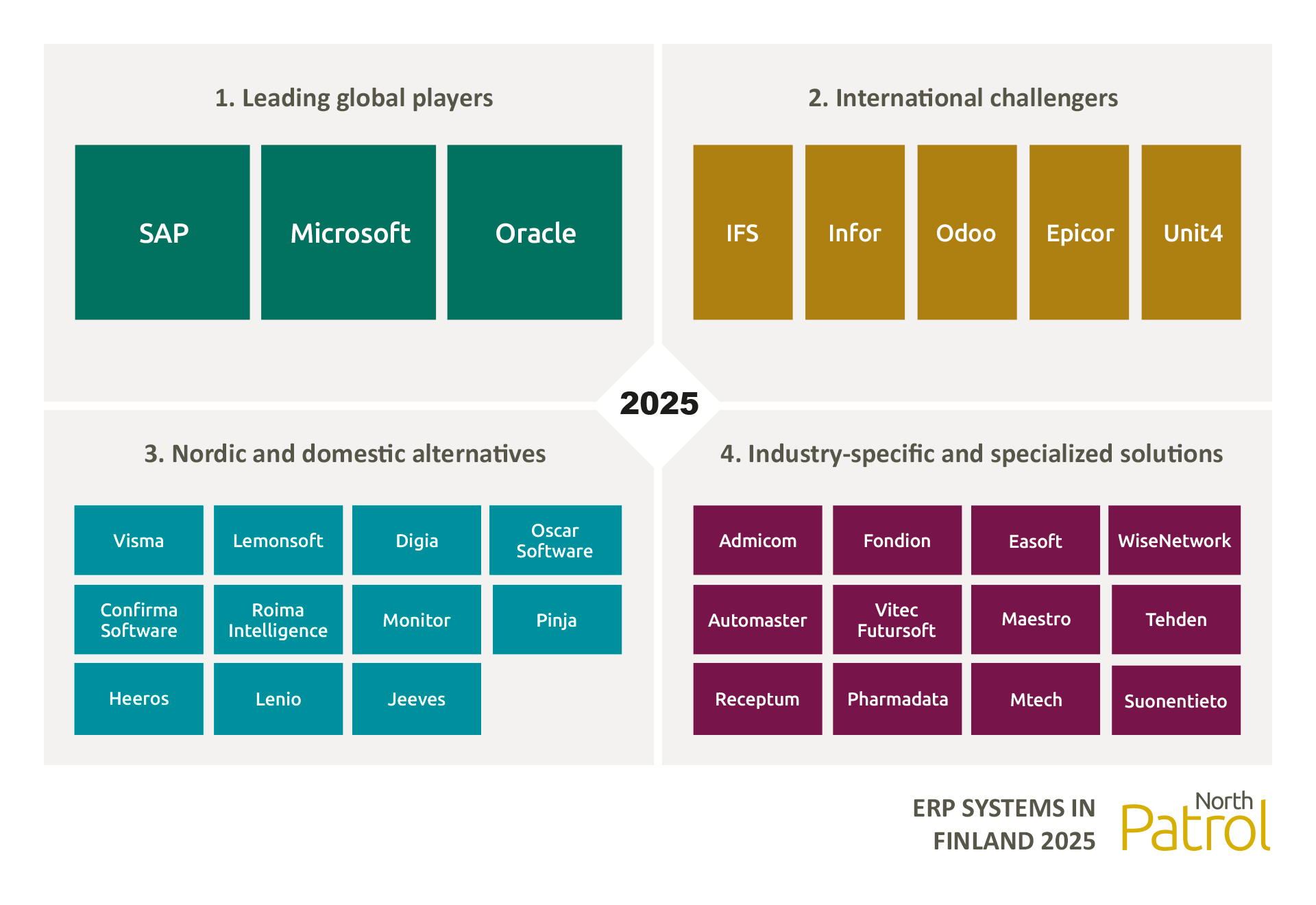
North Patrol conducted a review of the Finnish ERP market in 2025. In this overview, we present the key ERP solutions available in the Finnish market. The solutions have been grouped into four categories: leading global players, international challengers, Nordic and domestic alternatives, and industry-specific solutions designed for specialized needs.
North Patrol is a consulting firm specialized in the design of digital services and information systems. We shape ideas into a vision and service concept, find the best architectural and technological solutions, design a functional user experience, and compete to find the ideal partner for implementation work. We do not sell implementation projects, nor do we sell licenses; we are genuinely on the side of the customer.
An enterprise resource planning system (ERP) is a software solution that brings together a company’s core functions and enables the management of areas such as finance, production, inventory, customer relationships, and human resources. ERP systems consolidate information from different parts of the business, making it possible to process and monitor data centrally.
An ERP system typically consists of several modules that cover different functions. The scope of implementation, delivery model, and suitability of the system vary depending on the size and needs of the organization. ERP solutions are available for many different requirements; for different industries, for companies of different sizes, and for different types of use cases.
ERP adoption continues to grow in Finland
The use of enterprise resource planning systems in Finnish companies has grown steadily over the past two decades. In the early years, ERP systems were primarily tools for large enterprises — systems used to manage complex supply chains, production, and financial administration. Since then, technological development, a more diverse range of solutions, and the spread of cloud-based alternatives have made ERP increasingly accessible and relevant for SMEs as well. The growing use of ERP systems reflects the digitalization of the Finnish business landscape and its maturation toward more systematic and data-driven operations.
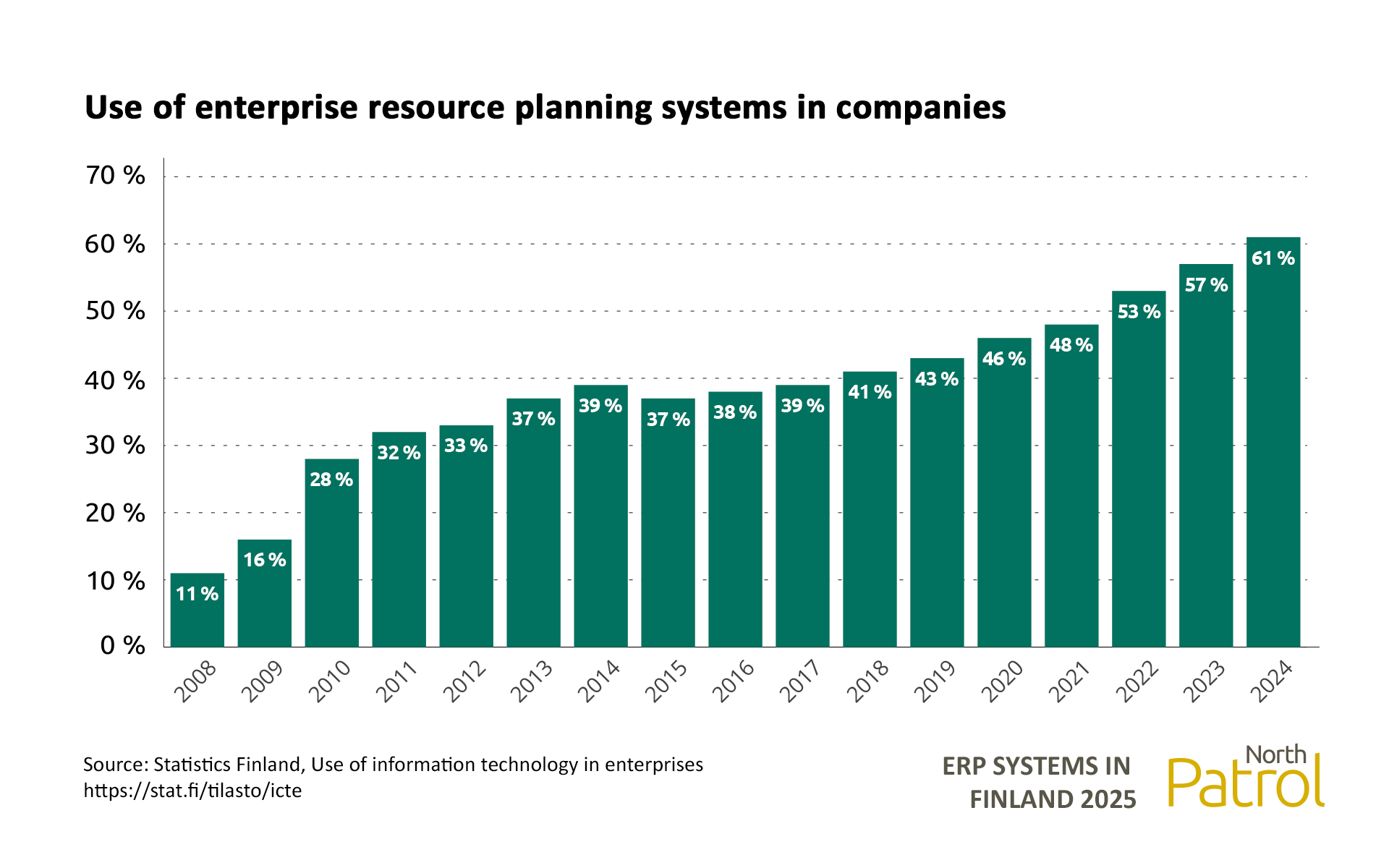
In 2008, only 11 percent of Finnish companies used an ERP system. By 2024, the figure had already risen to 61 percent. Growth has been particularly rapid over the past ten years, and ERP systems have become a central part of day-to-day business in an increasing number of industries.
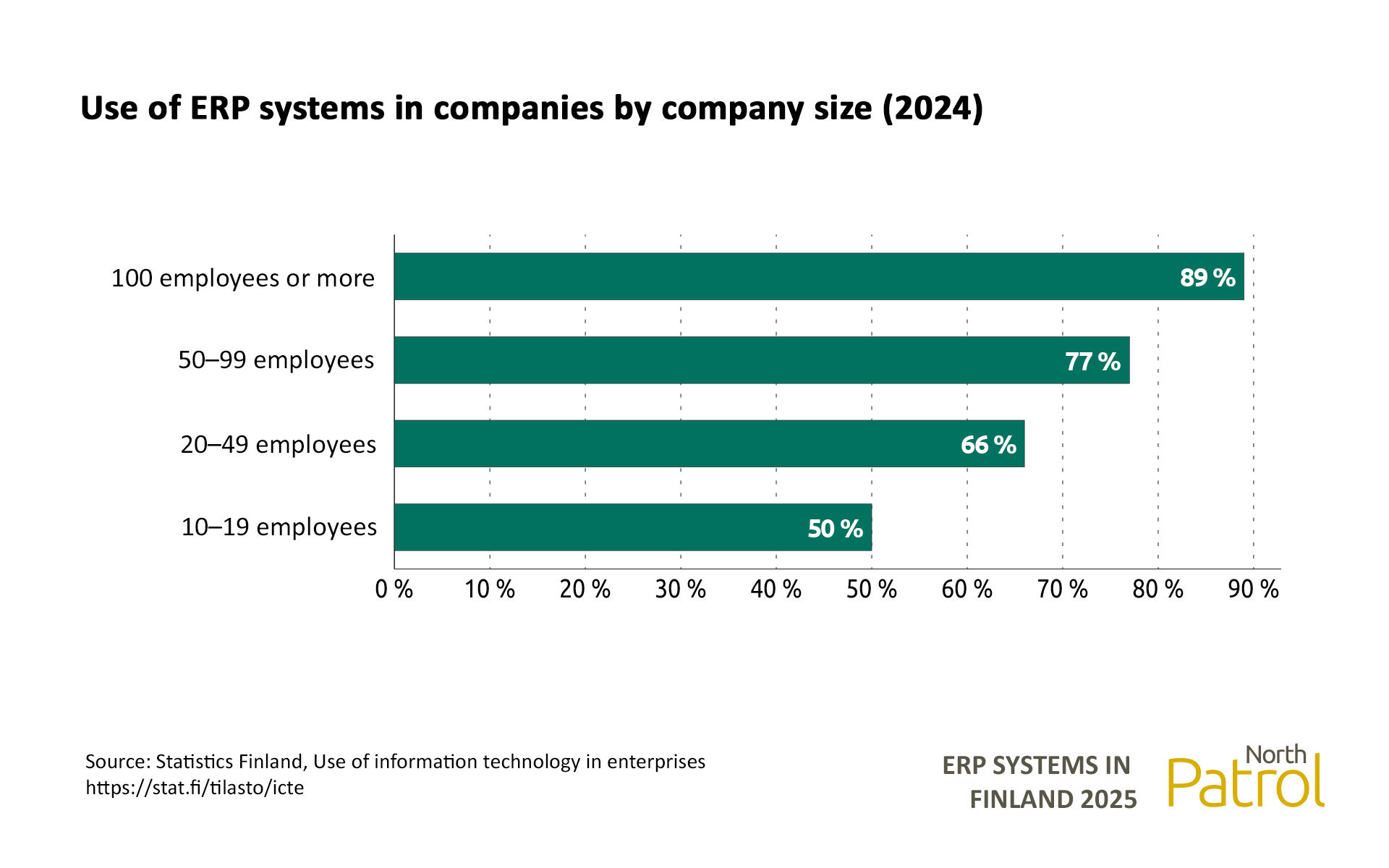
The use of ERP systems remains strongly linked to company size. According to Statistics Finland, around 90 percent of companies with more than 100 employees use ERP systems. At the same time, ERP adoption has increased significantly also in the SME sector: as many as 50 percent of companies with 10–19 employees now use an ERP solution to support their business.
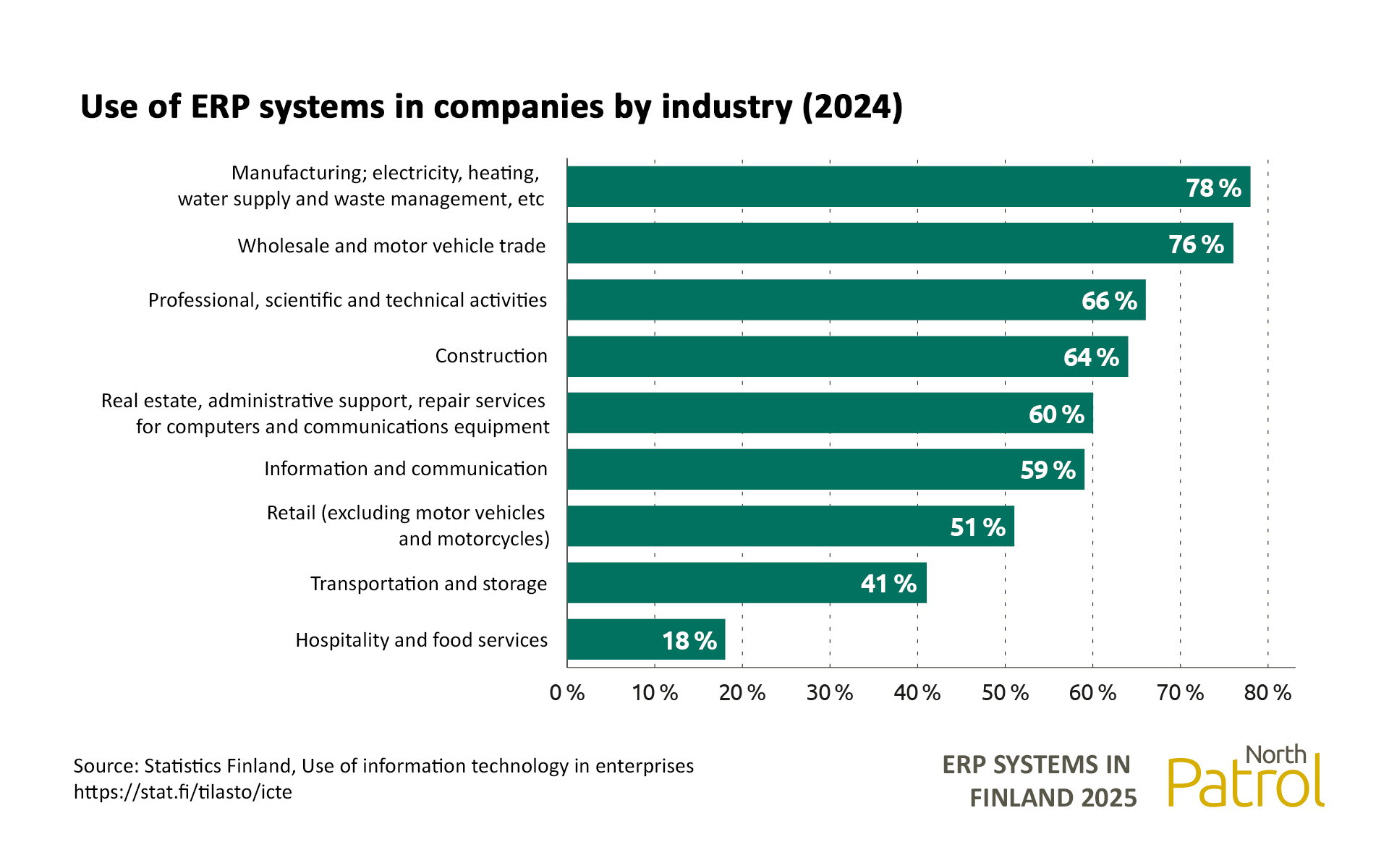
ERP usage also varies considerably by industry. For example, manufacturing, wholesale trade, and the technical and professional services sector have adopted ERP systems widely. In these sectors, more than two out of three companies use ERP. By contrast, the use of ERP systems remains less common in accommodation and food services, where fewer than one in five companies have implemented such a system.
ERP solutions in Finland – four main categories
In this study, we examine what kinds of ERP solutions Finnish companies use and how different products are positioned in the market. We have grouped the ERP systems available in Finland into four main categories based on the providers of the systems:
Leading global players – international ERP solutions designed especially for the needs of large and internationally operating enterprises.
International challengers – solutions that compete with the biggest vendors especially in the mid-market segment.
Nordic and domestic alternatives – regionally strong vendors whose solutions are designed especially for Finnish and Nordic requirements.
1. Leading global players: SAP, Microsoft and Oracle
The leading players in the global ERP market are the German SAP and the US-based Microsoft and Oracle. Their solutions are designed especially for large, internationally operating organizations with extensive and complex business processes.
The SAP, Microsoft, and Oracle ERP systems offer highly comprehensive functionality and are suitable for many different industries. Although these products are primarily targeted at large enterprises, they also offer lighter versions that address the needs of mid-sized organizations.
These vendors are not only ERP houses, but providers with a broad portfolio of technologies across other solution areas as well. All three have strong investments in cloud services, data utilization, and artificial intelligence.
Their own ecosystems create a significant competitive advantage. They are built on extensive product and service portfolios as well as comprehensive global and local partner networks. SAP, Microsoft, and Oracle have all grown significantly both organically and through acquisitions.
All three have a strong country organization in Finland, which enables customers to combine local support and expertise with international resources.
SAP
SAP SE is a German software company and one of the world’s leading suppliers of ERP systems. The company’s core expertise lies in broad ERP solutions aimed at improving customers’ business processes, increasing productivity, and reducing costs through automation, analytics, and integrated functionality. In addition to ERP systems, SAP has a very broad offering in other areas as well. Its portfolio includes solutions for customer relationship management, e-commerce, and human resources, among others. In this way, SAP serves as a unified business platform for many large organizations.
Over the past few years, SAP has gone through a major cloud transformation in which the focus has shifted from traditional on-premise systems to modern, scalable cloud services — especially the SAP S/4HANA Cloud platform. The transition has not been entirely painless: many customers have found cloud migrations demanding both technically and operationally. However, the change has been strategically necessary for SAP in order to secure its leading position going forward.
SAP in Finland:
Country organization: SAP Finland Oy
Number of employees: 133 (12/2023)
Implementation and service partners include Vincit, CGI, and Vivicta
SAP S/4HANA
SAP S/4HANA is SAP’s flagship product, designed especially for large enterprises and international groups. Typical customers are organizations with extensive and complex business processes as well as significant customization and integration needs. The aim is often to manage diverse business operations as far as possible on one unified platform, and SAP S/4HANA offers broad capabilities and a large number of different applications and modules for this purpose. The product is not limited to any specific industry, but is a highly versatile general-purpose solution.
SAP S/4HANA is available in several versions. The Cloud Public Edition, offered as SaaS, enables faster implementation but has limited customizability. Cloud Extended Edition is more extensible and customizable than the public version. If more control is needed, Cloud Private Edition can be used in a dedicated server environment. In addition, local on-premise installation or different hybrid models are also possible.
In Finland, SAP S/4HANA is used by organizations such as Vaisala and Posti Group.
SAP Business ByDesign
SAP Business ByDesign is SAP’s ERP alternative for the needs of mid-sized companies. It is a cloud-based ERP solution delivered fully as SaaS. SAP Business ByDesign includes standardized modules for finance, project management, human resources, sales, and supply chain management, among others. The product can be implemented relatively quickly without heavy infrastructure, major upfront investments, or complex customization.
In Finland, SAP Business ByDesign is used by, for example, log house manufacturer Kontiotuote.
SAP Business One
SAP Business One is SAP’s more affordable and compact ERP solution for smaller organizations. The solution is available both as an on-premise installation and as a cloud service, and it is suitable for companies that need a fast, cost-effective, and easy-to-use system.
Business One includes the core ERP functions such as finance, inventory management, purchasing, sales, and customer relationship management. The system also supports light production control and reporting, and additional extensions are available for the needs of different industries.
Among Finnish organizations, Aulis Lundell Oy uses SAP Business One.
Microsoft
Microsoft is one of the world’s largest technology companies and operates across several solution areas. The company has invested heavily in cloud services, and its strategy increasingly relies on artificial intelligence, automation, and support for hybrid work.
ERP systems are also an important part of Microsoft’s offering. Product names and packaging have changed repeatedly over the years. Today, however, the overall portfolio falls under the cloud-based Dynamics 365 product family. Microsoft’s key ERP products are Dynamics 365 Finance and Dynamics 365 Supply Chain Management. These modules are often used together because organizations typically need to manage both their financial processes and their supply chain as one integrated whole, although separate use is also fully possible. In addition, the overall solution can be complemented with other D365 modules, such as Dynamics 365 Project Operations for project-based business. As a more complete ERP solution for mid-sized companies, Microsoft offers Dynamics 365 Business Central.
Finland has traditionally been a strong Microsoft country, and in addition to a strong local organization, there are also many capable partners in Finland.
Microsoft Dynamics 365 Finance (D365 Finance) is Microsoft’s cloud-based financial management solution for large and mid-sized companies with demanding reporting, budgeting, and closing requirements, for example. The system covers core finance processes such as general ledger accounting, payments, taxation, fixed asset management, and cost tracking. D365 Finance supports global business operations with multiple currencies and accounting standards. The product is widely used across different industries, such as energy, logistics, financial services, and manufacturing.
In Finland, D365 Finance is used by YIT, for example.
Microsoft Dynamics 365 Supply Chain Management
Microsoft Dynamics 365 Supply Chain Management (D365 SCM) is a versatile solution for supply chain, production, and inventory management. It is used to manage material flows, production control, maintenance, demand forecasting, and distribution. In addition, the product includes capabilities such as predictive maintenance through remote monitoring. As a solution, it is particularly suitable for mid-sized and large industrial and manufacturing companies with extensive supply chains and a need for efficient resource management. D365 SCM integrates tightly with the D365 Finance module, but it can also function as a standalone solution.
In Finland, D365 SCM is used by companies such as Lumon.
Microsoft Dynamics 365 Business Central
Microsoft Dynamics 365 Business Central (D365 BC) is a comprehensive ERP solution for mid-sized companies. It covers financial management, sales, purchasing, inventory, customer relationship management, project management, and light production control on one platform. Compared with heavier ERP systems, D365 BC is relatively quick to implement. In addition, Business Central is generally considered a user-friendly ERP system.
In Finland, several organizations use Business Central, including Finlayson and Unisport.
Oracle
Oracle is one of the world’s most significant technology companies, with core business areas built around complementary solutions. At the heart of its operations are database solutions and a broad range of cloud-based applications for different industries. Oracle also offers its own cloud infrastructure (Oracle Cloud Infrastructure, OCI) in various service models.
In the ERP market, Oracle is one of the leading global names. In Finland, Oracle NetSuite, which is aimed especially at mid-sized organizations, and the on-premise Oracle E-Business Suite (EBS) have been popular. Oracle Fusion Cloud ERP, in turn, is suitable for global corporations. In addition to actual ERP systems, Oracle also offers separate solutions, for example for human resources management (HCM) and supply chain and manufacturing management (SCM).
Oracle Fusion Cloud ERP is a cloud-based ERP solution designed especially for large and internationally operating companies. The system adapts to complex business processes and supports multi-company structures. Fusion Cloud ERP includes functionalities for finance, procurement, risk management, and enterprise performance management (EPM), among other areas. The solution is used widely across different industries.
In Finland, Skanska, for example, uses Fusion Cloud ERP to support its business.
Oracle NetSuite
Oracle NetSuite is a fully cloud-based ERP system for mid-sized companies, delivered as a SaaS service. The solution includes a broad range of ready-made modules such as production control, inventory management, invoicing, time entries, and customer relationship management (CRM).
NetSuite is often described as an “all-in-one” solution due to its versatility and integratability. Although it does not offer as extensive features as Fusion Cloud ERP, it meets the needs of most companies very well. For an ERP system, the user interface is relatively user-friendly, and implementation is comparatively fast.
Among Finnish customers, Kyrö Distillery Company and Oura use NetSuite.
Oracle E-Business Suite
Oracle E-Business Suite (EBS) is fundamentally an on-premise ERP solution that covers a broad range of modules for different use cases. It is an established and technically mature system that continues to be actively supported. It should nevertheless be noted that Oracle’s product development focus is now strongly on cloud solutions. Still, EBS can remain a suitable option for organizations that need to maintain the solution in an environment they control themselves.
Among Finnish customers, Fortum, for example, uses Oracle E-Business Suite.
2. International challengers: IFS, Infor, Odoo, Epicor, and Unit4
Unlike the global market leaders, which build broad ecosystems across multiple solution areas, the international challengers focus on their core competence, i.e. delivering high-quality ERP systems. Many of them also offer industry-specific solution packages aimed at accelerating implementation and directly addressing the needs of specific sectors.
In the ERP market, the key challengers include Sweden’s IFS, the US-based Infor, and the fast-growing Belgian open-source vendor Odoo. This group also includes the US-based Epicor and the Dutch Unit4. Most of these vendors also have either their own country organization in Finland or an active partner network.
Although Sage belongs to the same group globally, its ERP products currently have no known implementations or partners in the Finnish market.
IFS
IFS is a Swedish software company that today has more than 7,000 employees in around 80 countries. In recent years, IFS has expanded its footprint beyond the Nordics, particularly in the UK, the German-speaking parts of Europe, and the United States. IFS’s customer base includes organizations in energy, defense, aviation, and construction, among others.
IFS has had operations in Finland for a long time. Its subsidiary IFS Finland Oy Ab, which provides local support and expertise for the implementation and maintenance of IFS solutions, was established as early as 1989.
IFS Cloud ERP is a cloud-based ERP system that combines several business processes on one platform. Its strengths include enterprise asset management (EAM) and field service management (FSM), which makes IFS Cloud ERP a good solution for companies managing equipment, maintenance, and field service operations. The product also supports project management, which is especially important in construction and contracting.
IFS’s ERP system is used by companies such as Junttan and Cimcorp Oy.
Infor
Infor is a software company that is part of the massive Koch Industries group. It is not as widely known as SAP, Oracle, or Microsoft, but Infor is a global company with offices in more than 40 countries.
Infor has several ERP solutions and different packaged offerings for selected industries. Enterprise resource planning can also be complemented with capabilities for human capital management (HCM), supply chain management (SCM), and sustainability reporting. The main ERP-product is Infor M3.
Although Infor is a US-based company, it also has a significant presence in Finland and the Nordic region. Its country company, Infor Global Solutions Oy, operates in Espoo and serves customers in industries such as manufacturing, healthcare, and retail.
Infor in Finland:
Country organization: Infor Global Solutions Oy
Number of employees: 50 (12/2023)
Implementation and service partners include CGI and Navcite
Infor M3
Infor’s main product is the Infor M3 ERP system. It is particularly suitable for companies that have several production plants, warehouses, or sales channels — often also in different countries.
Infor M3 is an ERP system designed especially for manufacturing and for complex business processes. Its strengths lie in deep specialization in supply chain management, inventory management, and production optimization. Industry-specific packages and configurations go a long way, although naturally complex business processes may sometimes also require customization.
Although an on-premise version of Infor M3 is also available, Infor’s development path is strongly cloud-based.
In Finland, Infor M3 is used by, for example, Meira. In addition, the industry-specific Infor CloudSuite Food & Beverage package is used by at least Snellman and Saarioinen.
Odoo S.A.
Odoo S.A. is a Belgian company originally founded in 2005 that has grown into an organization of more than 5,500 employees. The company and its main product established the Odoo name in 2014. The company’s growth has been remarkable in recent years, and it has attracted significant investors.
The company’s founder, Fabien Pinckaers, remains as principal owner and CEO and he has sometimes been described as the Belgian Bill Gates. Although Odoo has grown into a global player, Pinckaers has kept both the company’s roots and most of Odoo’s product development in Belgium.
Odoo in Finland:
No local country organization, headquarters in Belgium
Odoo can be classified as an ERP system, but in practice it is more an integrated collection of different business applications that form a unified platform. The overall solution includes applications for sales and marketing, financial management, human resources, product lifecycle management, inventory management, website creation, and much more.
Odoo is fundamentally open source, but the development of the core product and its Enterprise version is led by Odoo S.A. New major versions of the product are released once a year. Odoo can be installed on-premise or in environments provided by Odoo S.A. (Odoo Online and Odoo.sh). In practice, all even moderately demanding implementations in Finland have largely been delivered as local on-premise installations. For environments, Odoo partners rely on their own hosting partners such as UpCloud and Hetzner Finland.
In Finland, Odoo is used by companies such as Pentik, Fescon, and Suomalainen Kirjakauppa.
Epicor
Epicor Software Corporation is a global company with 4,600 employees in 34 countries. In Finland, Epicor has offices in Vantaa and Vaasa. In terms of industries, Epicor especially serves automotive, construction, distribution, manufacturing, and retail.
Epicor’s offering includes several solutions. Of its ERP systems, Epicor Kinetic is intended for manufacturing and Epicor Prophet 21 for distributors. Epicor iScala, in turn, is more of a financial management solution. In addition, Epicor also offers other software solutions such as customer relationship management (CRM), supply chain management (SCM), and human capital management (HCM).
Epicor Kinetic is a cloud-based ERP solution designed especially for mid-sized manufacturing companies. The solution is used by companies producing industrial equipment, electronics, and furniture, among others.
Epicor Kinetic supports complex production processes such as Make-to-Order (MTO), Engineer-to-Order (ETO), and Configure-to-Order (CTO), and provides tools for streamlining them. The Kinetic license includes the visual Epicor Application Studio tool, which allows users to tailor the system to their own needs.
In Finland, Epicor Kinetic is used by companies such as Kiilto and Premekon.
Unit4
Unit4 is a software company focused on providing cloud-based ERP solutions especially for service-oriented organizations, for whom flexibility, efficiency, and a people-centered approach are important. Unit4 therefore competes with the leading vendors especially in service-oriented industries.
Unit4 has many customers in both Finland and the Nordics. Its customer base includes expert organizations, public sector actors, non-profit organizations, and educational institutions. In Finland, Abilita offers a tailored Municipal ERP solution for the municipal sector, combining finance, HR, and reporting.
Unit4 in Finland:
Country organization: UNIT4 Oy
Number of employees: 11 (12/2023)
Implementation and service partners include Efima, Abilita (Municipal ERP), and Vivicta
Unit4 ERP
Unit4 ERP is a cloud-based software solution that provides tools for finance, human resources, project management, and procurement. It also includes reporting and analytics capabilities. As its platform, Unit4 ERP uses Microsoft Azure. An on-premise model is also possible, but Unit4’s strategy is to move customers fully to a cloud-based SaaS model.
Unit4 ERP is a modular system whose structures and processes can be modified relatively flexibly. As a system, it is quite user-friendly. For example, users of the ERP can create and modify workflows and reports without actual technical expertise.
In Finland, customers of Unit4 ERP include Sitowise, ARE, and the City of Rauma.
3. Nordic and domestic alternatives
The ERP solutions presented above are large international systems aimed especially at large and often internationally operating companies. However, the market also offers a wide range of Nordic and domestic ERP systems that respond particularly well to the needs of Finnish SMEs.
In this chapter, we present ERP solutions designed for the Finnish and Nordic markets. These are usually general-purpose and versatile systems developed to meet local requirements and legislation.
A typical feature of these alternatives is that the software vendors themselves handle the delivery and implementation of the system without a separate partner network. Unlike international vendors, these providers do not typically operate on a partner model but manage customer relationships directly.
Visma
Visma is a Norwegian-origin company that has expanded through acquisitions. At times, business units have also been divested from the group. In Finland, the group includes more than ten small and mid-sized companies employing altogether around 1,500 people. The management, key personnel, customer service, and sales of Visma’s subsidiaries operate independently, although the group has shared finance, HR, and ICT functions.
Visma’s offering includes many different software products as well as several ERP systems. Fikuro is a system for SMEs covering ERP, production control, and inventory management. Visma Nova is an ERP system for wholesale trade, specialty retail, manufacturing, and SMEs. Visma L7, in turn, is a comprehensive ERP and financial management solution for contracting, energy, and industrial companies.
In Finland, these solutions are used by organizations such as Realplast (Fikuro), Eurosec (Visma Nova), and Elvera (Visma L7).
In addition, Visma offers different industry-specific ERP solutions such as Tampuuri for property management and DomaCare for the care sector. The portfolio also includes Severa, aimed at managing expert organizations. Visma’s financial management systems Netvisor and Fivaldi are also widely used.
Lemonsoft
Lemonsoft is a Finnish listed company originating from Vaasa that competes in the market particularly through its domestic roots. Overall, Lemonsoft operates in eight locations. In terms of industries, Lemonsoft serves especially manufacturing, wholesale and specialty retail, construction, expert and service companies, and accounting firms.
Lemonsoft’s ERP system includes all of the company’s key functions in one package. These include customer relationship management, project management, reporting, time tracking, financial management, payroll and HR administration, logistics, and inventory management. Customers can select the functions they need and pay only for the features they use.
Lemonsoft’s ERP system is used by companies such as Oulun Remonttimylly and Several.
Digia
Digia is a Finnish software and services company with more than 1,500 employees and operations also in Sweden and the Netherlands. Digia operates across several solution areas, and its customers include organizations in the public sector, industry, finance, and healthcare.
Digia has extensive experience with various ERP systems. In addition to Microsoft and Oracle products, Digia also offers ERP solutions of its own development. The most significant of these is Digia Envision, an ERP and financial management system developed especially on Finnish terms. The product is suitable for wholesale trade, the food industry, machinery trade, and industrial companies. The system includes tools for order and supply chain management, production control, customer relationship management, and inventory management. In addition, Digia Envision has modules for service, maintenance, and quality and self-monitoring management.
Among Finnish companies, Digia Envision is used by E. Ahlström Oy, Hedengren, and Laattapiste, for example.
In addition, Digia offers the Digia Logistics ERP system especially for logistics and freight-forwarding companies.
Oscar Software
Oscar Software is a Finnish software company employing around 120 people. It has offices in Tampere, Espoo, and Raisio. Oscar offers solutions for the different phases and processes of both wholesale trade and manufacturing. Oscar also relies strongly on its domestic roots.
Oscar Software’s main product is a business platform, powered by the versatile Oscar ERP system. The solution is designed especially for the needs of domestic SMEs. For manufacturing, Oscar ERP provides tools for production planning and control, materials management, quality control, and supply chain management. For wholesale trade, the system covers all key functions from order-to-delivery chain management to CRM and reporting tools.
Oscar ERP is used by food service company Menumat and wholesale supplier Boldan, which specializes in sewer lining materials and equipment.
Confirma Software
Confirma is a Nordic company headquartered in Sweden. Altogether, the group employs more than 560 people in Finland, Sweden, Norway, and Denmark. In Finland, Confirma operates in six locations. In addition, Confirma has local resellers. Its offering includes ERP software, POS solutions, online stores, financial management services, and property management systems.
Confirma has three actual ERP solutions. Quick3 ERP is designed particularly for companies in machinery, spare parts, and maintenance. Its key functions include sales and purchasing, versatile service functions, inventory management, CRM, and electronic financial management. Prime ERP is a solution suitable for demanding business environments such as wholesale trade and supports even complex processes. Confirma NetBaron provides real-time information and automation to support business. It is designed to streamline business processes and work management especially in manufacturing.
In Finland, Confirma’s ERP systems are used by companies such as Mekonomen Ilmajoen Autotelakka (Quick ERP) and Suomen Ilotulitus Oy (Confirma NetBaron). Prime ERP has also been used by Duell, at least.
In addition, Confirma has several industry-specific software solutions, such as Confirma Active for sports and fitness centers. It is also worth mentioning that Flowvy, originally Finnish and quite widely used as an e-commerce solution, is today part of Confirma Software.
Roima Intelligence
Roima Intelligence operates in five countries and employs more than 400 experts. The company serves customers across a wide range of industries. Roima also has a broad offering of software products and expert services.
Roima’s ERP business dates back to 2015, when it acquired the Lean System ERP solution from the former Tieto. After that, the product has been developed under Roima’s own ownership. Today, the Lean System suite includes not only ERP functions but also comprehensive MOM functionalities (Manufacturing Operations Management). Roima states that Lean System supports engineer-to-order planning, mass production, mass customization, project deliveries, contract manufacturing, and aftermarket and spare parts sales. The solution can be acquired either as a cloud-based SaaS service or as an on-premises installation.
Lean System ERP is used by companies such as Fodelia and Planmeca.
Monitor
Monitor ERP System AB is a Swedish company that today operates in 13 countries. However, the majority of its more than 500 employees work in Hudiksvall, Sweden, where the company’s headquarters are located. Most of the company’s product development also takes place there. Monitor also has a Finnish country company in Turku.
Monitor ERP is a very popular ERP system in its home market of Sweden, and it is also used to some extent in Finland. It is intended especially for manufacturing companies. The system consists of six integrated modules: production, purchasing, sales, inventory, time reporting, and accounting.
Finnish customers of Monitor ERP include the metal industry company Matimek and Green Automation Group.
Pinja
Pinja is a software company with more than 550 employees, offering solutions for supply chain management, industrial production, and sustainability. Headquartered in Jyväskylä, the company operates in eight locations in Finland.
Pinja has developed its own ERP system called Total ERP. The core idea of the product is to make work more efficient. Total ERP adapts to the customer company’s processes and integrates with the necessary financial management systems and BI solutions. Daily management, such as complex cost estimation, production and installation resourcing, and scheduling are supported by various tools.
Total ERP by Pinja is used by companies such as EcoUp and Trendi Kaihdin.
Other Nordic and domestic alternatives
In addition to these, the market offers several other alternatives from nearby regions.
Heeros PSA by Heeros is an ERP solution for expert organizations. Its capabilities include project management, time tracking, customer relationship management, reporting, resourcing, and invoicing. Heeros PSA can also be integrated seamlessly with the most common financial management software. The system is used by, for example, Lahdelma & Mahlamäki Architects.
Jeeves, originally a Swedish company that is now owned by UK-based Forterro. The company focuses on providing ERP solutions for mid-sized companies. Jeeves’ customers operate mainly in manufacturing, production, distribution, wholesale, and services. Their ERP solution is called Jeeves ERP. The cloud-based product consists of seven integrated applications. In Finland, Jeeves ERP is used by, for example, Vivantti Oy. At least Proseduuri acts as a domestic implementation partner for the solution.
Lenio is a software company based in Tampere, and its ERP system Lenio TOP is designed for the daily needs of small and mid-sized organizations with mobile and remote work. Its customer base includes installation, moving, renovation, maintenance, and expert companies, as well as companies in the energy and security sectors. Lenio TOP is used to manage quotations and deliveries, receive orders, allocate work, and handle invoicing. Lenio TOP is used by, for example, the locking and security company Avain-Asema Oy.
4. Industry-specific and specialized solutions
Alongside general-purpose ERP systems, the market also offers several solutions designed around a specific industry or a narrowly defined use case. These systems can be seen as industry-specific ERP solutions or specialized systems in which the special characteristics of a certain profession, business logic, or operating environment are emphasized. Below is a selected sample of such solutions used in the Finnish market.
Admicom's Admicom Ultima is a comprehensive solution for SMEs in building services engineering and construction. There is also Admicom Ultima Lite, developed to serve the needs of small businesses, and Admicom Flex, aimed especially at fieldwork and property maintenance.
Fondion is an ERP solution designed for project management and operations management in the construction industry, covering areas such as quantity takeoff, cost tracking, resourcing, and scheduling.
Easoft ERP is targeted at the operations management needs of renovation, construction, and building services companies. Easoft’s offering also includes Easoft Asset and Firasor ERP, which are designed for the operations management of the real estate sector.
Tampuuri, already mentioned in connection with Visma, is also an industry-specific solution for property management.
Automaster DMS is a widely used system among car dealerships and service workshops, supporting dealer management, vehicle and spare parts sales, and service operations management, among other functions. Automaster is today owned by Keyloop.
Vitec FuturSoft offers industry-specific ERP solutions especially for the vehicle and machinery sectors. Autofutur is aimed at car repair shops and spare parts stores, while Konefutur serves the needs of machinery sales and maintenance. Both systems include features tailored to their industries, and they are widely used among Finnish SMEs.
Maestro Toiminnanohjaus is an ERP solution developed for the needs of specialty retail. Mediamaestro Oy’s offering also includes industry solutions for car and tire dealerships.
Tehden ERP is aimed at Finnish SMEs in the retail sector. Tehden Oy also has a product called Tehden Liikunta for companies in the sports and fitness sector.
WiseNetwork’s WisePlatform ERP system is used as an industry solution especially in gyms, sports centers, event management, and golf clubs. WisePlatform includes several tools within one system: customer management, websites, and marketing, sales, and financial management functions.
The pharmacy ERP market is likewise shared by two vendors: Receptum and Pharmadata. The name of Receptum’s pharmacy system is MAXX, and Pharmadata’s is Omapd.
The market for ERP solutions in agriculture is in practice shared by two vendors: Mtech Digital Solutions and Suonentieto. At the core of Mtech’s offering is the My Farm platform (Minun Maatilani), which includes tools and services for optimizing agricultural operations, increasing productivity, and improving environmental sustainability. Suonentieto’s key software products are Maatalousneuvos, Agrineuvos, and Balanssi.
How the review was conducted
The overview of the Finnish ERP market has been carried out as expert work by North Patrol. The article was written by Mikko Jokela and Sami Kalanen.
The work draws on experience from Finnish client projects, vendors’ websites, user reviews, discussion forums, and international reports and market overviews. Expertise related to the use of the different solutions in Finland was mapped through LinkedIn. The statistical information presented is based on the data in Statistics Finland’s Use of information technology in enterprises statistics, updated in early 2025 (https://stat.fi/tilasto/icte). In addition, inspiration was drawn from AI and from the views of Gartner and other analyst firms, for example.
North Patrol independently compiled and categorized the key ERP solutions available in the Finnish market. The purpose of the review is not to provide a complete list of all possible products or detailed comparisons of their features, but to help organizations renewing their ERP systems structure the market and find direction for their own choices.
North Patrol Oy, which conducted the review, is an independent expert company, with no ties to any IT vendors and technologies. It helps clients design digital solutions and information systems, choose technologies, and run procurement processes for implementation partners.
Sami Kalanen, M.Sc. (Eng), is an expert in project planning, requirement specification, and tendering.
Sami consults with customers on project preparation and definition of requirements, and supports customers in competitive bidding and oversight of vendors’ implementation work. His areas of specialisation include broad, technically challenging web projects and competitive bidding in the public sector.
Sami has been working with web projects since the mid-1990s. Earlier in his career Sami worked in IT procurement at a large industrial company, in management roles at software vendor companies, as Managing Director and a partner at an independent consulting firm and as product manager for a telecommunications operator.
We’re eight experienced consultants — designers and technology specialists — focused on vendor-neutral, practical results. Every year, we complete 30-40 customer engagements with customer satisfaction at 9.5/10. Clients come to us to make confident decisions and deliver better digital services.
A small engagement is ideal when you need a clear answer to a specific question, a tough decision supported by independent analysis, or simply a quick outside view.
Pricing is a fixed fee agreed in advance to keep things predictable, and getting started is as simple as sharing your goals and any background material so we can propose a crisp scope and price.
Prestudy & feasibility evaluation projects
A prestudy is the right choice when you are framing a larger initiative, building internal alignment, or testing whether an idea is worth pursuing — for example a platform change, a new digital service, a consolidation effort, or an AI/automation use case.
In four to eight weeks we interview key stakeholders, map needs, assess the current state across content, architecture, integrations, and governance, and combine vendor‑neutral market insight with technical feasibility and risk analysis.
We then outline effort, budget, and timeline ranges with clear assumptions and scenarios, and we shape a high‑level solution concept and target architecture sketch.
Supervision & quality control for technical implementation
Independent supervision is most effective when you already have a delivery partner and want oversight that keeps scope, quality, and budget on track.
We manage risks, provide executive‑level updates, support acceptance testing, and conduct readiness reviews before go‑live.
Finnish site version available — most reports and expert articles are published there.