Please note that this article is over 14 years old, so the content and links may not necessarily be up to date. For more recent reading, you might be interested in one of these articles:
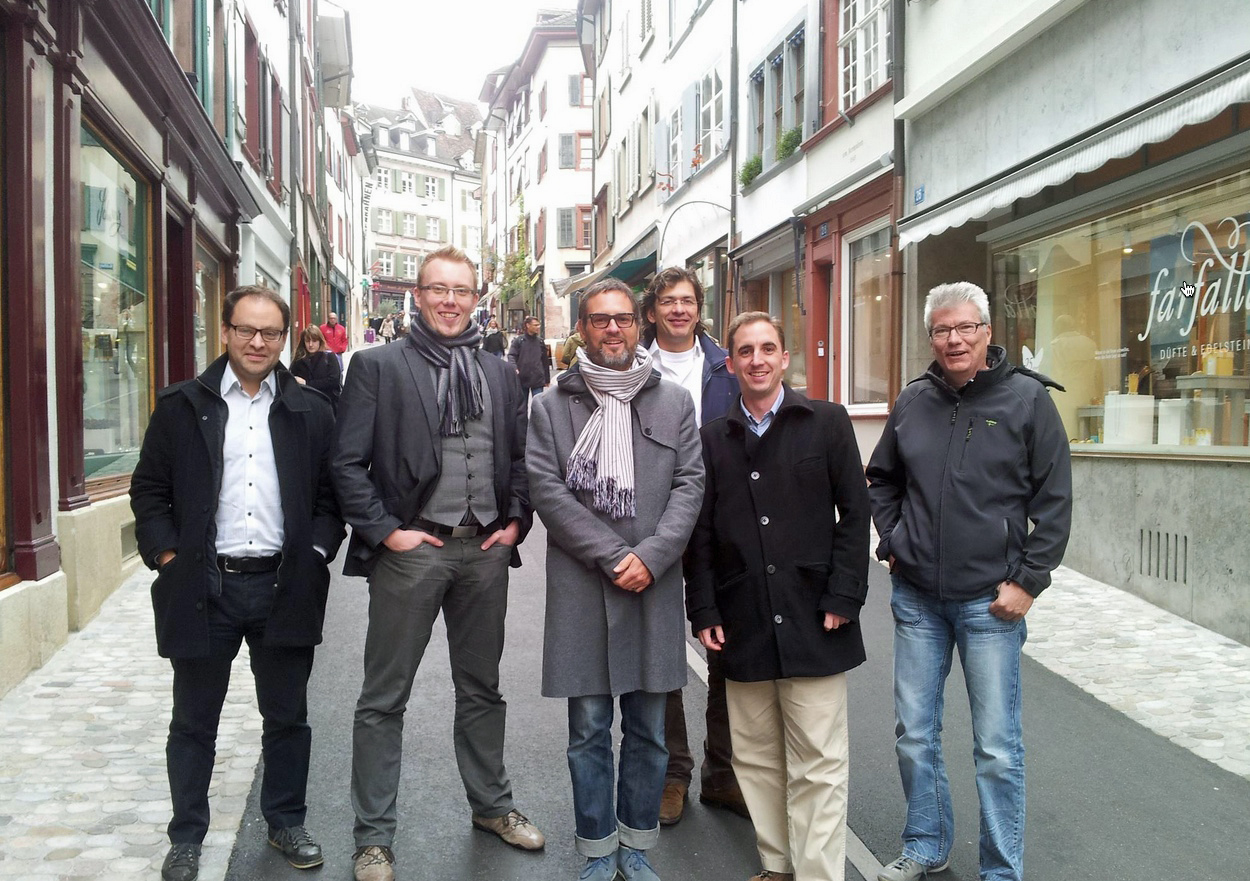
CMS Expert Group Europe met in Basel in October. Issues on the table covered CMS usability issues, performance and optimization in web projects and we also took a look at CMS related marketing buzzwords like WEM and other new acronyms.
This time participants were mainly consultants and vendors (eg. Magnolia, Oracle, Onion.net), only Dan Jackson from London University College representing a customer with timely CMS challenges.
I will next outline my three main takeaways from the meeting. The takeaways are not direct observations from the meeting discussions, but more about my personal insights that got reinforced during the trip.
North Patrol is a consulting firm specialized in the design of digital services and information systems. We shape ideas into a vision and service concept, find the best architectural and technological solutions, design a functional user experience, and compete to find the ideal partner for implementation work. We do not sell implementation projects, nor do we sell licenses; we are genuinely on the side of the customer.
This article is a part of CMS selection article series by North Patrol.
North Patrol helps customers to make smart technology decisions and find the best implementation partners. Typically, we facilitate prestudy projects and evaluate vendors and proposals. Most of our clients are large companies headquartered in Finland.
1) The "web marketing machine" is definitely one possible "Web CMS 2.0" concept direction
In practise, currently vendors are quite lost in executing this vision. And it also isn't really clear that how much you can do in terms of productization in that area. Personalization, content targeting and suggestion profiles are areas which are very customer-specific. You can have "rules engine" and "content targeting based on dynamic groups", but setting these areas up requires quite lot of work every time. Also vendors are painting a very rosy picture about that future direction but don't want to mention that keeping this sort of "big marketing machine" running smoothly requires dedicated resources for managing the website.
2) User interfaces for CMSs are ripe for redesign
And right now tablets and other touch devices are a good reason to redesign your CMS user interface. Magnolia gave a good example of how you can completely rethink the user interface for a CMS. For example, Magnolia's upcoming version 5 has a UI that can be used with tablets, smartphones and desktop computers. The UI has a lot of similarities to Apple's iOS in the sense that all the features are packaged as applications within the CMS. And moving between those different applications has a lot of similarities to iOS world. Perhaps having a CMS user interface in your tablet is not a reality for many organizations quite yet, but this is the direction where things are going.
3) Application store ideology is taking over the world of CMSs
Many customers are using tools like Google Analytics, but doing extensions for 3rd party applications is something that is often not very reasonable to do as a core feature of the CMS. However, other sectors are learning that becoming a platform for other parties to do extensions also benefits CMS vendors. Most importantly because these extensions can be usually updated more often and more easily than the core features of the CMS. However, this development direction has not been easy for CMS vendors, and many are struggling with it. Even popular vendors like EPiServer have not been very fast to adapt to this kind of "standardized extension model". Fortunately it seems that right now many CMS vendors are becoming forced to enable this kind of development. One major reason for vendors to do this is naturally Drupal. Drupal has been gaining ground fast all over Europe and Drupal's widely popular extension model has quite long been something that the other vendors just haven't had.
The development direction towards application stores for CMSs is something that can also have wider implications. It could be even argued that competing future direction in regards of "Web CMS 2.0" is the rise of the application stores. This move could benefit CMSs that are very good in offering their core services and extending that core with a strong offering of useful extensions. This development direction is popular especially on open source markets, but there really isn't good reasons why commercial products could not take advantage of this development direction as well.
CMS Expert Group Europe will meet next time in London in February 2013.
Perttu Tolvanen is a web concept design and content management system expert.
Perttu consults with clients on project planning and defining requirements, and supports customers in selecting content management systems and implementation partners. His areas of specialisation include facilitating concept design workshops and selecting content management systems.
Perttu has ten years of experience with web and intranet projects, including serving as a project manager and consultant. Earlier in his career Perttu has worked in procurement and as a project manager at a large media company, a content management system consultant at a large IT company and an independent, neutral consultant at his own firm. He is also a well-known seminar speaker and blogger. Perttu is also the editor of Vierityspalkki.fi, a Finnish blog about the Finnish internet and its creators.
We’re eight experienced consultants — designers and technology specialists — focused on vendor-neutral, practical results. Every year, we complete 30-40 customer engagements with customer satisfaction at 9.5/10. Clients come to us to make confident decisions and deliver better digital services.
A small engagement is ideal when you need a clear answer to a specific question, a tough decision supported by independent analysis, or simply a quick outside view.
Pricing is a fixed fee agreed in advance to keep things predictable, and getting started is as simple as sharing your goals and any background material so we can propose a crisp scope and price.
Prestudy & feasibility evaluation projects
A prestudy is the right choice when you are framing a larger initiative, building internal alignment, or testing whether an idea is worth pursuing — for example a platform change, a new digital service, a consolidation effort, or an AI/automation use case.
In four to eight weeks we interview key stakeholders, map needs, assess the current state across content, architecture, integrations, and governance, and combine vendor‑neutral market insight with technical feasibility and risk analysis.
We then outline effort, budget, and timeline ranges with clear assumptions and scenarios, and we shape a high‑level solution concept and target architecture sketch.
Supervision & quality control for technical implementation
Independent supervision is most effective when you already have a delivery partner and want oversight that keeps scope, quality, and budget on track.
We manage risks, provide executive‑level updates, support acceptance testing, and conduct readiness reviews before go‑live.
Finnish site version available — most reports and expert articles are published there.